

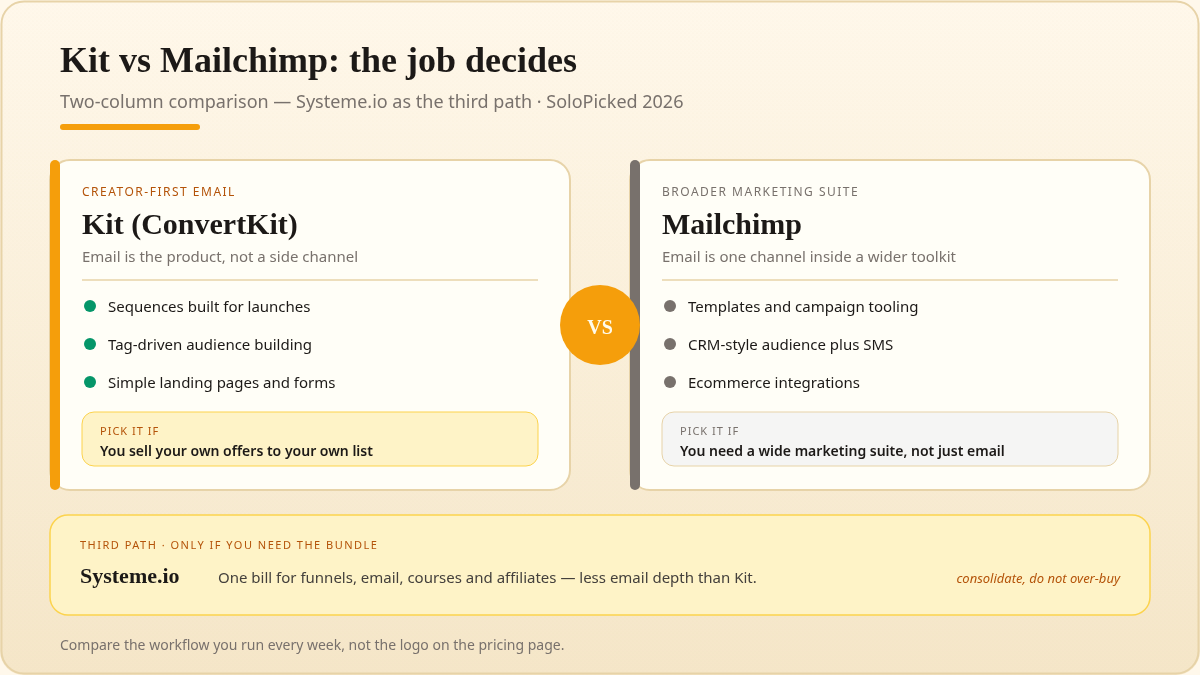
Kit (formerly ConvertKit) and Mailchimp are two of the most common email platforms creators compare before they build a list. This page focuses on Kit vs Mailchimp as the primary decision. Systeme.io appears as a third-path note when you need funnels and courses in one subscription — see also our Systeme.io review and Systeme.io pricing.
This article is editorial research from public documentation and pricing pages. We do not invent hands-on lab tests. Affiliate links, if present, are placeholders until programs are approved; see the Affiliate Disclosure.
Email is still the most durable owned-audience channel for creators, coaches, and solopreneurs. But “email platform” now means very different things. Kit, Mailchimp, and Systeme.io all send newsletters, build landing pages, and automate follow-ups — yet they are built around different business models.
This is a research-based editorial comparison, not a hands-on lab test. It is based on public documentation, pricing pages, feature descriptions, and common migration guidance available at the time of research. Pricing and plan limits change frequently, so treat all figures as directional and verify current details on each vendor’s site.
Affiliate disclosure: This post contains affiliate links. If you purchase through one, SoloPicked may earn a commission at no extra cost to you. Read our full affiliate disclosure.
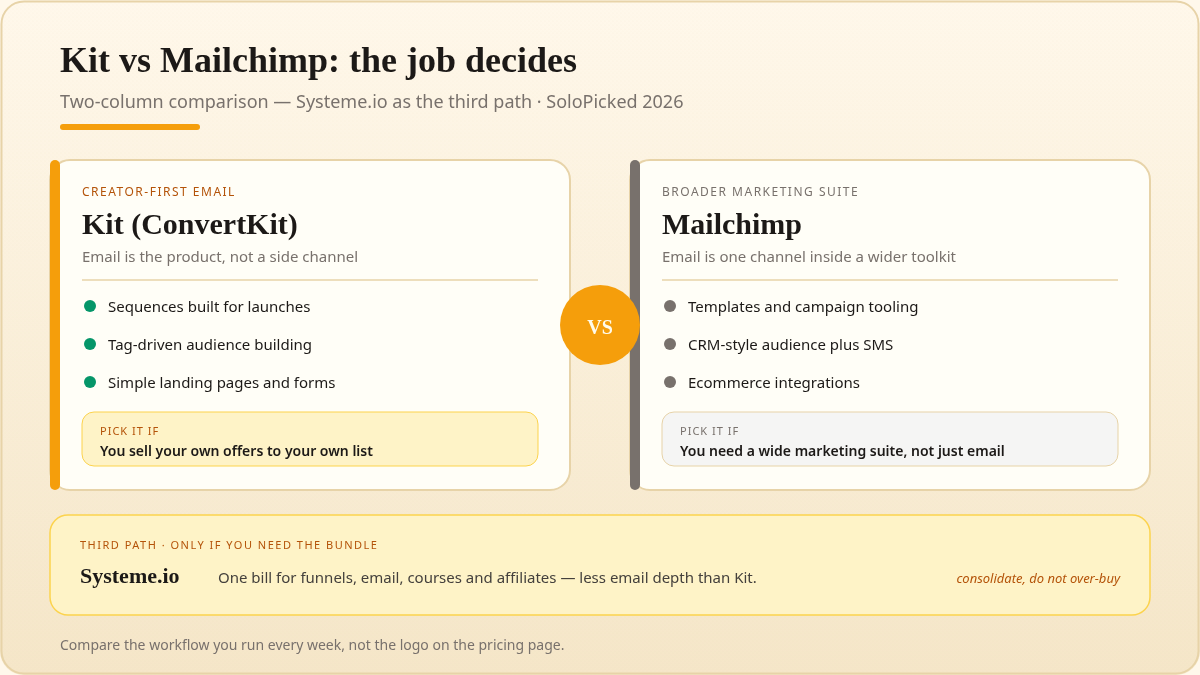
Illustrated chart (warm amber / cream). Not vendor UI.
Quick verdict: Kit vs Mailchimp (and when to look at Systeme.io)
| If your priority is… | Start with | Why |
|---|---|---|
| Newsletter-first audience building, creator monetization, and simple tagging/automation | Kit (ConvertKit) | Creator-focused email tooling, forms, landing pages, sequences, and recommendation-style growth features |
| A broad marketing suite with templates, CRM-style audience management, SMS, and ecommerce integrations | Mailchimp | Mature all-in-one marketing platform with strong brand recognition and many integrations |
| Replacing several tools with funnels, courses, email, and affiliate management in one budget-friendly stack | Systeme.io | All-in-one funnel, course, email, and affiliate toolkit with aggressive plan packaging |
Short version: Kit is usually the best fit for newsletter-led creators and coaches who want email to be the center of the business. Mailchimp fits established brands and ecommerce-leaning teams that need a wider marketing suite. Systeme.io is the value pick for course creators and funnel builders who want to consolidate tools.
Kit (formerly ConvertKit): the creator-first email platform
Kit’s public positioning is unusually clear: it is built for creators. That shows up in the product language around subscribers, tags, forms, landing pages, email sequences, and visual automations. Kit is not trying to be a full website builder or a general-purpose CRM. It is trying to be the email engine behind a creator business.
What Kit does well, based on public docs
- Newsletter-first workflow. Kit’s core experience is built around sending broadcasts to subscribers, segmenting with tags, and running sequences. For creators who publish regularly, that focus reduces the “where do I click?” problem that broader marketing suites can create.
- Tag-based automation. Kit uses tags and visual automations to trigger sequences and segment audiences. This is a practical model for creators who want to send different offers to different reader groups without building a complicated CRM.
- Forms and landing pages. Kit includes creator-friendly forms and landing pages for lead magnets, newsletters, and waitlists. Public plan descriptions often gate some landing page or form limits by tier, so check current limits.
- Creator monetization features. Kit has added features aimed at helping creators recommend products, run sponsor-style recommendations, and grow through creator networks. Exact availability varies by plan, but the strategic direction is clearly creator monetization rather than generic email marketing.
- Integrations. Kit integrates with common creator tools such as course platforms, membership tools, ecommerce systems, and automation connectors. This matters because many creators prefer best-in-class tools rather than one mega-suite.
Where Kit can fall short
- Not a full funnel or course builder. If you want to build a multi-step sales funnel, host a course, and manage affiliates inside one dashboard, Kit will usually require integrations or additional tools.
- Advanced automation is plan-gated. The free tier is useful for starting a newsletter, but serious automation, sequencing, and scaling features generally require a paid plan.
- Pricing scales with subscribers. That is normal for email platforms, but it means a fast-growing list can move you into higher tiers quickly.
Who Kit is for
Kit is a strong fit for newsletter writers, podcasters, YouTubers, coaches, and digital product sellers who want email to be the primary relationship channel. It is especially appealing if you already use dedicated tools for courses or checkout and only need a clean email and landing-page layer.
Mailchimp: the broad marketing suite
Mailchimp is the most established brand in this comparison. Its public feature set goes well beyond email: audience management, templates, automations, SMS, landing pages, website tools, social media marketing, analytics, and ecommerce integrations. That breadth is the point — and also the trade-off.
What Mailchimp does well, based on public docs
- All-in-one marketing breadth. Mailchimp can handle email campaigns, basic CRM-style audience organization, automation journeys, SMS (where available), and reporting. For small teams that want one vendor for several marketing channels, that can reduce tool sprawl.
- Templates and design. Mailchimp has a large library of email templates and a drag-and-drop editor. Creators who want polished campaign design without custom coding often find it approachable.
- Ecommerce and integrations. Mailchimp has deep integrations with ecommerce platforms and many third-party apps. If you sell physical products or run a store, its ecommerce-oriented features and reporting can be more relevant than Kit’s creator-first model.
- Free entry point. Mailchimp’s free plan is useful for testing the platform, but public plan descriptions typically impose contact and monthly send limits. It is not designed to be a full-featured free tier forever.
- Analytics and reporting. Mailchimp provides campaign reporting and audience insights that can be useful for teams that need to show marketing performance beyond opens and clicks.
Where Mailchimp can fall short
- Pricing complexity. Mailchimp’s pricing can depend on contact count, send volume, plan tier, and feature access. Public pages often show entry prices that increase meaningfully as your audience grows or you need more advanced automation.
- Creator monetization is not the core. Mailchimp can send a newsletter and sell products through integrations, but it is not built around creator recommendation networks, paid newsletter logic, or the specific workflows many solo creators want.
- Feature gates can surprise you. Some automation, multivariate testing, and advanced reporting features are limited to higher tiers. Always map your required features to the current plan comparison.
- Course and funnel hosting are not native strengths. Mailchimp’s landing pages and website tools are useful, but it is not a dedicated course platform or affiliate-management system.
Who Mailchimp is for
Mailchimp makes the most sense for established small businesses, ecommerce brands, and marketing teams that need a recognizable all-in-one suite with templates, reporting, SMS, and broad integrations. It can work for creators, but it is usually not the most creator-specific choice.
Systeme.io: the all-in-one funnel and course stack
Systeme.io is built around consolidation. Its public plans bundle email campaigns, funnels, landing pages, websites, online courses, communities, automations, and affiliate management. For solopreneurs and coaches who are tired of stitching together five subscriptions, that packaging is the main attraction.
What Systeme.io does well, based on public docs
- Funnels and landing pages are native. Systeme.io includes funnel-building and landing-page tools, so you can connect opt-ins, sales pages, upsells, and email follow-ups without leaving the platform.
- Courses and communities are included. Public plan descriptions position Systeme.io as a course and membership-friendly platform. That is a major differentiator against Kit and Mailchimp, which generally rely on integrations for course hosting.
- Affiliate management is built in. For creators who run affiliate programs, having affiliate tracking inside the same platform as funnels and email can simplify operations.
- Generous entry packaging. Systeme.io is known for aggressive plan packaging, including a free tier and paid tiers that combine contacts, funnels, and features. Public descriptions often emphasize unlimited emails on certain plans, but you should verify current fair-use and sending policies.
- Budget-friendly consolidation. If you are paying for an email platform, a funnel builder, a course platform, and an affiliate tool separately, Systeme.io’s bundle can be materially cheaper at the low end.
Where Systeme.io can fall short
- Email sophistication may be lower than dedicated tools. Systeme.io can send campaigns and automations, but creators who need highly polished newsletter workflows, advanced segmentation, or creator-specific monetization features may find Kit more refined.
- Design and template depth vary. If email design and brand polish are top priorities, compare the editor and template libraries directly. Broad all-in-one suites often trade depth for breadth.
- Ecosystem and integrations. Systeme.io has integrations, but it is not as universally connected as Mailchimp or as creator-native as Kit. Check that your checkout, course, analytics, and CRM tools connect.
- Plan limits still apply. “All-in-one” does not mean unlimited everything. Funnel counts, contact limits, file storage, and feature access can vary by tier.
Who Systeme.io is for
Systeme.io is a strong fit for coaches, course creators, and solopreneurs who want to launch funnels, host courses, email their list, and run an affiliate program from one dashboard. It is also a practical choice for budget-conscious creators who are willing to trade some email refinement for stack consolidation.
Feature comparison
| Feature | Kit | Mailchimp | Systeme.io |
|---|---|---|---|
| Newsletter broadcasts | Yes | Yes | Yes |
| Tag-based segmentation | Yes | Yes | Yes |
| Visual automations | Yes | Yes | Yes |
| Landing pages | Yes | Yes | Yes |
| Sales funnels | Limited / via integrations | Limited | Yes, native |
| Online courses | No, via integrations | No, via integrations | Yes, native |
| Community/membership features | Via integrations | Limited | Yes, included on some plans |
| Affiliate management | No, via integrations | No, via integrations | Yes, native |
| SMS marketing | Limited / via integrations | Yes, plan-dependent | Not a core strength |
| Creator recommendation/network features | Yes | No | No |
| Ecommerce integrations | Yes | Strong | Yes, digital-product oriented |
| Best-fit user | Newsletter-first creator | Broad marketing team or ecommerce brand | Course creator or funnel builder |
Pricing comparison (approximate signals)
The table below is directional only. It is not a quote. Email platforms commonly change prices, contact limits, send limits, and feature gates. Currency, billing cycle, annual discounts, and taxes also affect the real cost.
| Platform | Free tier signal | Entry paid signal | Higher-tier signal | Pricing model | Main caveat |
|---|---|---|---|---|---|
| Kit | Free plan for new newsletters, with feature and subscriber limits | Roughly $30/month range at small list sizes | Scales with subscribers and feature needs | Subscriber count + plan features | Advanced automation and creator features are plan-gated |
| Mailchimp | Free plan with contact and monthly send limits | Roughly $13–$20/month entry range, varies by contact count | Standard/Premium tiers can rise significantly | Contacts + send limits + feature tier | Best features and automation often require higher plans |
| Systeme.io | Free plan with contact and funnel limits | Roughly $27–$37/month entry range | Roughly $47–$97/month for broader tiers | Plan tiers with contact/funnel/feature limits | Verify fair-use email rules and current tier limits |
Pricing caveat: Do not choose based on the sticker price alone. Add your current list size, expected growth, required automations, course/funnel needs, and the cost of any integrations you would need to replace. A “cheaper” email tool can become expensive if it forces you to buy three other tools.
Migration notes: what to plan before switching
Migrating email platforms is rarely just an export/import. Public migration guides from all three vendors typically involve exporting contacts, importing them into the new platform, and then rebuilding automations, forms, and templates.
Before you migrate
- Export subscribers and tags. Most platforms can export contacts with consent status, tags, and custom fields. Check what metadata survives the export.
- Audit automations. List every welcome sequence, abandoned-cart flow, tag trigger, and re-engagement campaign. You will likely need to rebuild these manually.
- Inventory forms and landing pages. Decide which pages are still active. Recreate only the ones that drive revenue or list growth.
- Check deliverability setup. Plan for domain authentication (SPF, DKIM, DMARC) and warm-up if you are moving a large list. Do not switch providers during a major launch.
- Review compliance. Confirm consent records, unsubscribe handling, and data-processing terms. Especially important if you serve EU/UK audiences.
- Run a parallel test. Send a small campaign from the new platform before moving the full list. Check links, tracking, and automation triggers.
Platform-specific migration realities
- Migrating to Kit: Expect to rebuild tags, sequences, and visual automations. Kit’s creator-centric model is straightforward for newsletters, but course and funnel logic will usually stay in your existing tools.
- Migrating to Mailchimp: Audience import is common, but Mailchimp’s pricing and feature gates mean you should confirm your contact count and required automations before importing. Rebuild journeys in the journey builder.
- Migrating to Systeme.io: You may be consolidating funnels and courses, so migration is more of a rebuild than a simple import. Budget time for funnel pages, course content, and affiliate links.
Who should choose what?
Choose Kit if…
- Your primary business asset is a newsletter.
- You want a creator-focused email platform with tags, sequences, forms, and landing pages.
- You already use separate tools for courses, checkout, or funnels.
- You care about creator recommendation and monetization features.
- You want a simpler email workflow rather than a broad marketing suite.
Choose Mailchimp if…
- You need a recognizable all-in-one marketing platform.
- You run an ecommerce store or need broad integrations.
- You want email templates, reporting, SMS, and CRM-style audience tools.
- You have a marketing team that can manage plan tiers and feature gates.
- You are willing to pay for higher-tier automation and reporting when needed.
Choose Systeme.io if…
- You want funnels, courses, email, and affiliate management in one place.
- You are launching a coaching program, digital course, or membership.
- You are budget-conscious and want to reduce subscriptions.
- You can accept a less specialized email editor in exchange for consolidation.
- You want native affiliate tracking without extra tools.
FAQ
1. Which platform is best for creators overall?
For newsletter-first creators, Kit is usually the most natural fit because its public product design centers on creators, tagging, sequences, and audience growth. For course creators who need funnels and affiliate management, Systeme.io can be the better business fit. Mailchimp is strongest for broader marketing and ecommerce use cases.
2. Is Kit’s free plan enough to start?
It can be enough to validate a newsletter and collect subscribers, but public plan descriptions typically limit advanced features, automations, and landing pages. If email is your main revenue channel, budget for a paid plan sooner rather than later.
3. Is Systeme.io really an all-in-one replacement?
It can replace several tools for coaches and course creators, especially at the low end. But “all-in-one” does not mean best-in-class in every category. Check email editor depth, deliverability practices, course experience, and plan limits against your specific workflow.
4. Is Mailchimp good for coaches and course creators?
Mailchimp can send newsletters and automate follow-ups, but it is not a native course or funnel platform. Coaches who need course hosting, affiliate management, and funnel building may end up adding tools anyway, which reduces Mailchimp’s consolidation advantage.
5. Can I migrate my email list between these platforms?
Yes, generally through CSV export/import, but automations, tags, landing pages, and integrations usually need to be rebuilt. Always verify consent records, unsubscribe status, and domain authentication before sending to your full list.
6. Which platform has the best deliverability?
No vendor can guarantee inbox placement. Deliverability depends heavily on list quality, consent, authentication, sending reputation, and content. Kit, Mailchimp, and Systeme.io all publish deliverability guidance; compare their current documentation and follow best practices regardless of platform.
7. Which option is cheapest?
Systeme.io often has the most aggressive bundled pricing at entry levels, especially when you factor in funnels and courses. Kit can be cost-effective for newsletter-only creators, while Mailchimp’s costs can rise with contact count and feature tier. Always compare total stack cost, not just the email plan.
Final take
There is no universal winner here — only the platform that matches your business model. If your audience relationship lives in a newsletter, Kit is the most creator-aligned choice. If you need a broad marketing suite with ecommerce integrations, Mailchimp is the safer enterprise-adjacent option. If you want to consolidate funnels, courses, email, and affiliates on a budget, Systeme.io is the practical all-in-one pick.
Start with the business model, then verify current pricing and feature limits on each vendor’s site.
Research-based editorial. No hands-on testing, sponsored placement, or fake testimonials are represented in this comparison. Pricing and features should be verified before purchase.